Emerald Green & Tortoiseshell Nails: The Old-Money Luxury Look
You want your nails to look expensive — but not loud. Not rhinestones, not chrome for the sake of chrome, not five competing colors fighting for attention. You want the kind of manicure that looks like it belongs in a leather handbag ad, not a nail art competition.
That’s exactly what’s happening with the combination taking over Pinterest right now: deep emerald green, translucent tortoiseshell brown, and the barest hint of gold. It’s not a trend built on more — it’s built on restraint. And that restraint is precisely why it reads as “old money” instead of “trying too hard.”
Here’s how the formula works, why it works, and how to recreate it yourself — brush in hand or press-ons in a box.
Emerald tortoiseshell nails have become one of the most searched nail looks of the season, and for good reason: they translate a heritage-luxury aesthetic — the kind you’d normally associate with tortoiseshell eyewear, gold hardware, and deep jewel-toned accessories — directly onto the nail. Unlike trend-driven manicures that fade after a season, emerald tortoiseshell nails work year-round because the palette borrows from timeless materials rather than a passing color trend. If you’ve been searching for a manicure that photographs well, wears well with a neutral wardrobe, and doesn’t require a salon visit to recreate, emerald tortoiseshell nails are worth the extra ten minutes of patience the tortoiseshell layering step takes. For more shape inspiration to pair with this palette, see our guide to Almond Nail Shapes and Short Almond Nails, or browse Gold Nail Designs for accent ideas beyond the thin liner used here. For background on why tortoiseshell has been a design staple in fashion for decades, Vogue’s overview of the tortoiseshell trend is a useful reference point on where the aesthetic originated.
What Makes Emerald Green & Tortoiseshell Nails Look So Luxurious?
The short answer: contrast, texture, and editing yourself down to three elements instead of eight.
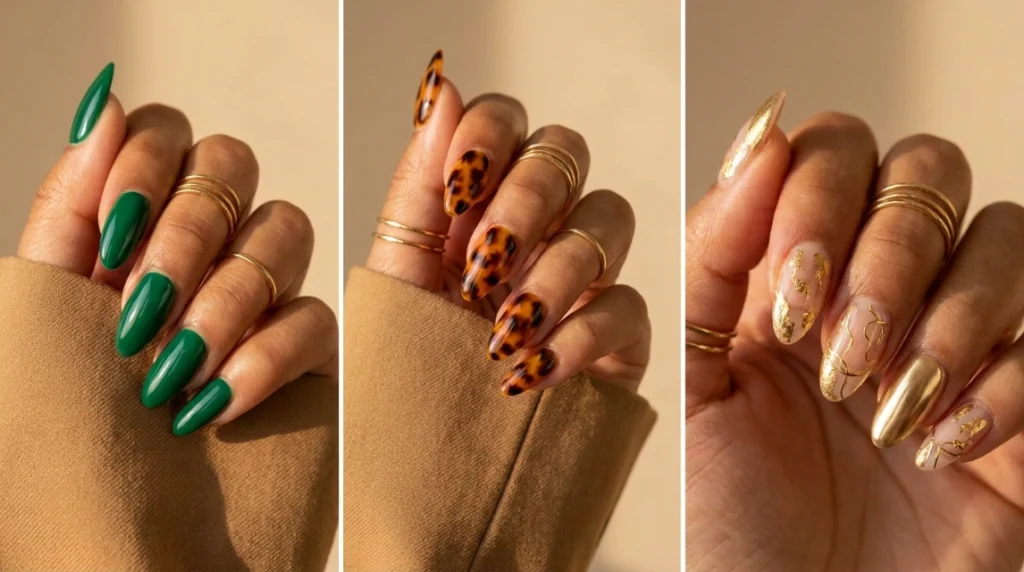
Emerald green does the heavy lifting. It’s a jewel tone, which means it already reads as rich rather than casual — think sapphire, ruby, emerald jewelry versus pastel gemstones. A glossy emerald nail catches light the way a stone does, and it sits beautifully against nearly every skin tone because of its depth.
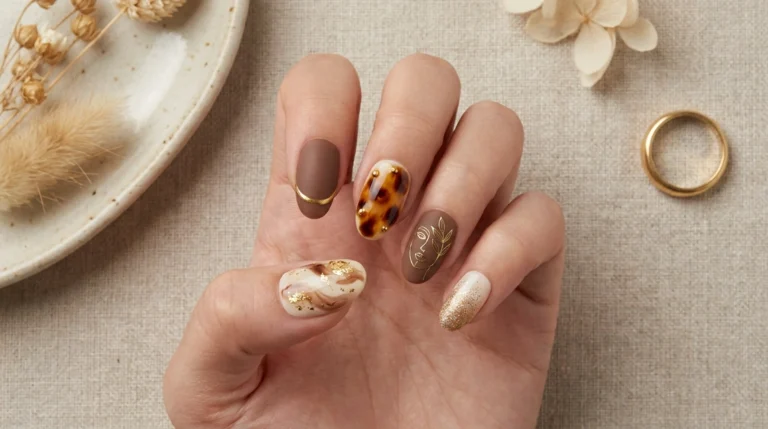
Tortoiseshell is doing something different. Instead of a flat color, it’s layered amber, caramel, and chocolate brown built up in irregular translucent patches — the same material language as vintage sunglasses, hair combs, and eyewear frames that have always signaled heritage rather than fast fashion. It’s warm where emerald is cool, which is exactly why the pairing works.
Gold is the accent, not the headline. A thin line, a tiny fleck, a single metallic border. The moment gold starts covering more than a sliver of the nail, the whole look shifts from “quiet luxury” to “costume jewelry” — so less is doing more work here than in almost any other nail trend.
The Color Formula
Think of it less like a recipe and more like a ratio you can adjust:
- Emerald green — the dominant color, roughly 2 out of every 5 nails
- Tortoiseshell — the textured contrast, roughly 2 out of every 5 nails
- Gold — accents only, never a full nail on its own
From there, you can lean into different pairings depending on the mood:
- Emerald + tortoiseshell — the classic, most dramatic version
- Emerald + gold — richer, more polished, less textured
- Tortoiseshell + gold — warmer, more vintage-coded
- All three together — the complete look, best saved for an accent nail or two so it doesn’t compete with itself
Nail Shapes That Work With This Look
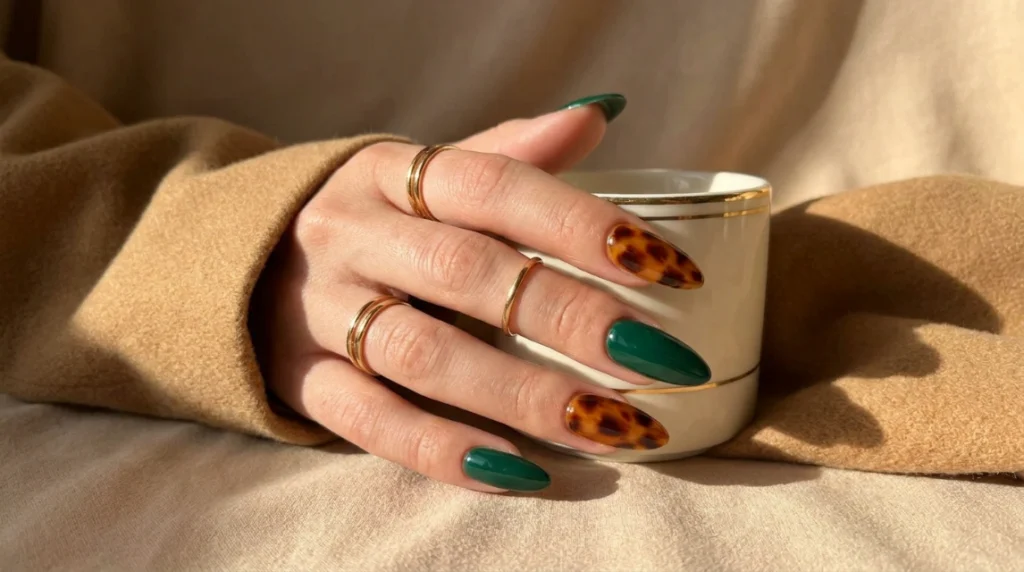
The reference image uses a long, tapered almond shape, but the palette translates across shapes:
- Long almond — closest to the original editorial look; the elongated tip gives the tortoiseshell pattern room to breathe
- Almond — the most universally flattering, easiest everyday version
- Stiletto — dramatic and fashion-forward, best for special occasions rather than daily wear
- Coffin — the flat tip gives the color-blocking a slightly more modern, geometric feel
- Short almond — the low-maintenance version of the same palette, ideal if you’re at a desk all day
How to Recreate Emerald Green & Tortoiseshell Nails at Home
Step 1 — Prep the nails
Shape your nails into your chosen silhouette, gently push back cuticles, and clean the nail plate with rubbing alcohol so polish adheres properly. Apply a ridge-filling base coat and let it dry fully.
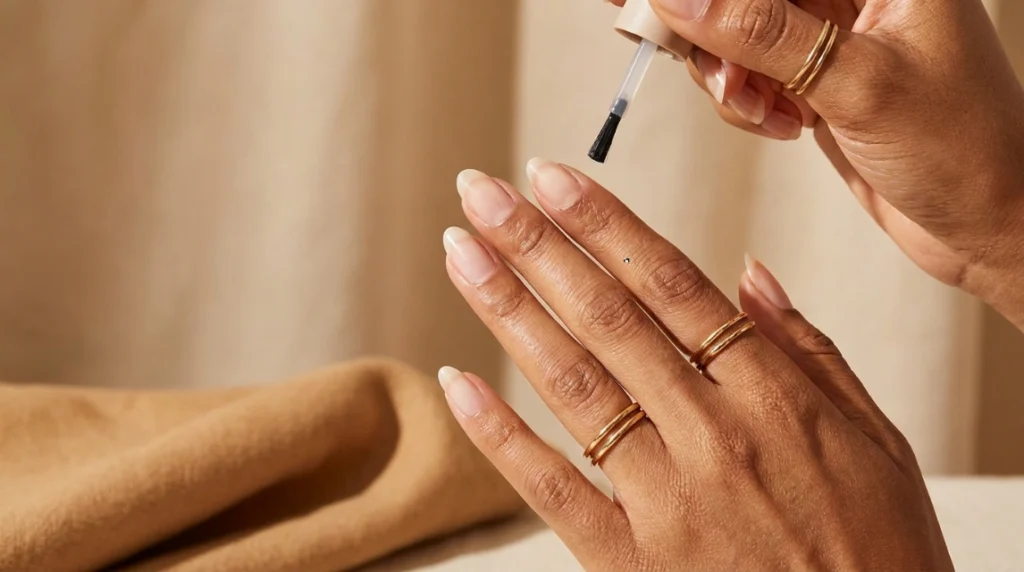
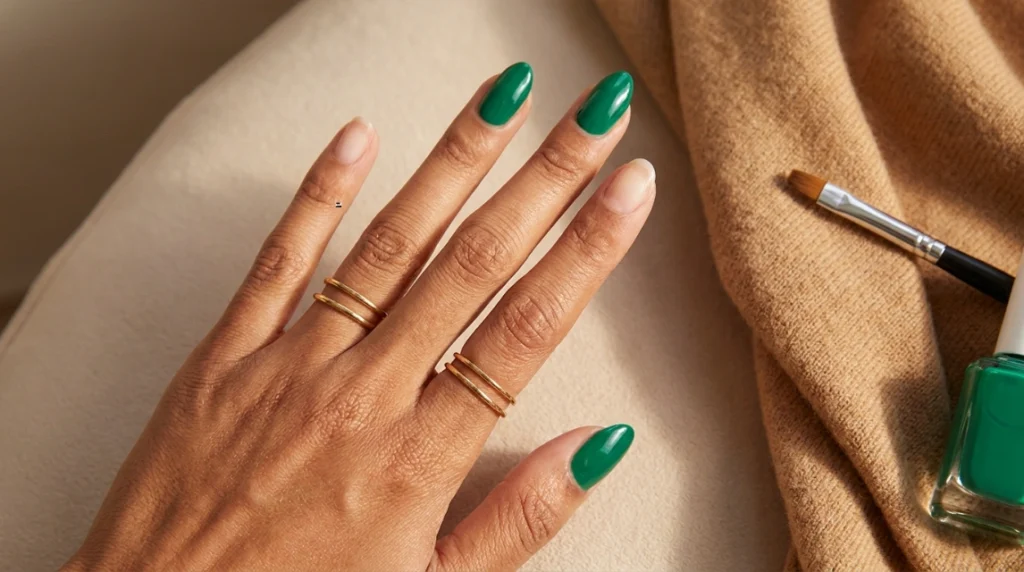
Step 2 — Paint the emerald nails
Choose 2–3 nails per hand to be solid emerald. Apply one thin coat, let it dry, then apply a second coat for full opacity and a rich, glassy depth. Keep the edges clean — this is a look built on precision, not texture, for the emerald nails specifically.
Step 3 — Build the tortoiseshell base
On your remaining nails, apply a warm, translucent amber or honey-brown base coat. This is the opposite of the emerald nails — you want it sheer, not opaque, so light can pass through it.
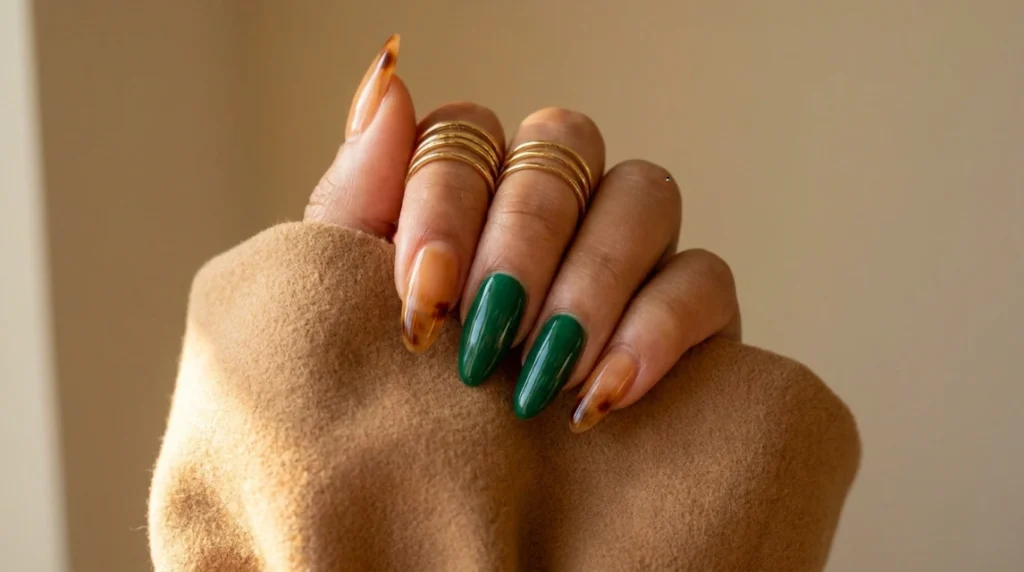
Step 4 — Add irregular brown patches
While the base is still workable, dab on uneven patches of medium brown and darker chocolate brown using a small detail brush or a dotting tool. The key word is irregular — avoid round, evenly spaced dots, which will read as leopard print instead of tortoiseshell.
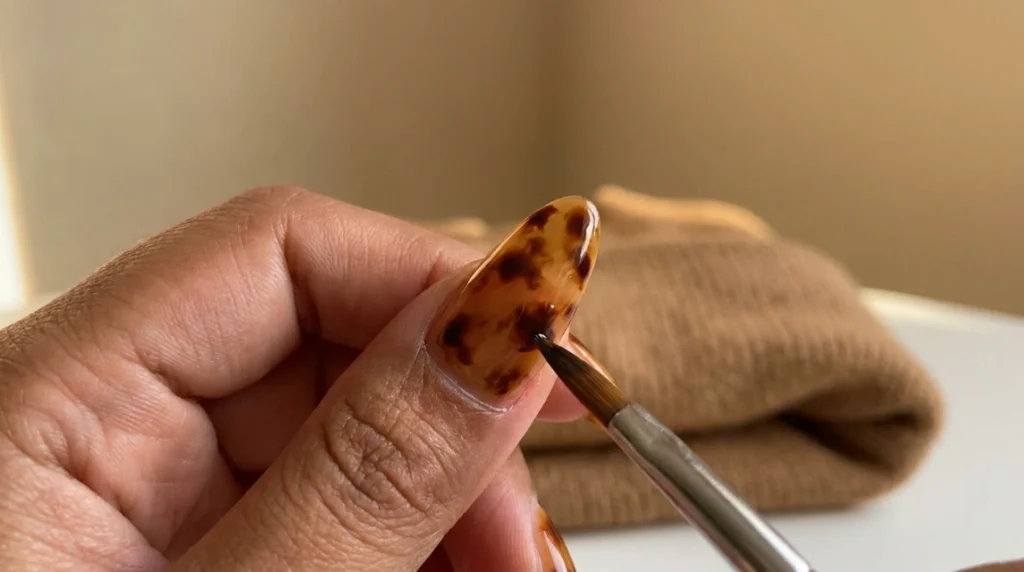
Step 5 — Layer for translucency
Once the patches are placed, brush a thin layer of transparent amber gel or polish over sections of the design. This softens the hard edges between colors and creates the layered, almost glass-like depth that separates real tortoiseshell from a flat brown-and-tan pattern.
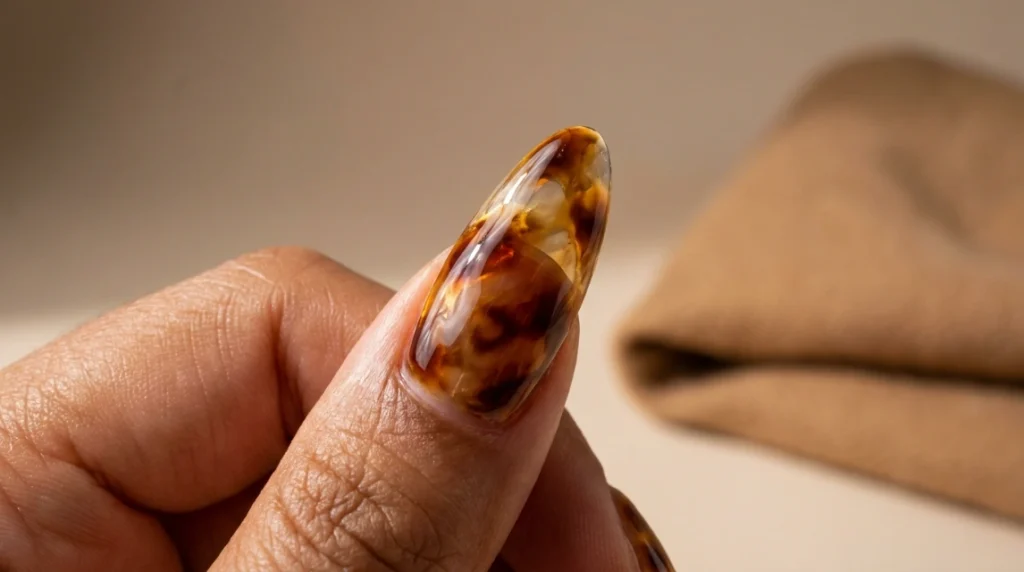
Step 6 — Add gold detailing
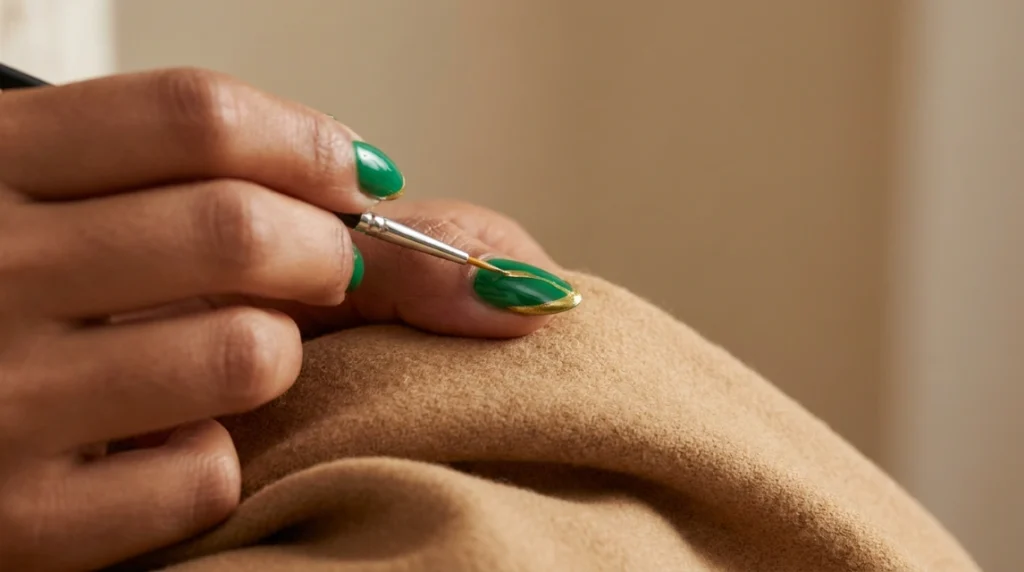
Using a fine liner brush and a metallic gold polish or gel, add your accents last. Good placement options: a single thin line along one edge of an emerald nail, a small curved accent near the cuticle, or a delicate gold French-tip line on one nail only. Resist the urge to add gold to every nail — one or two accented nails is the difference between elegant and cluttered.
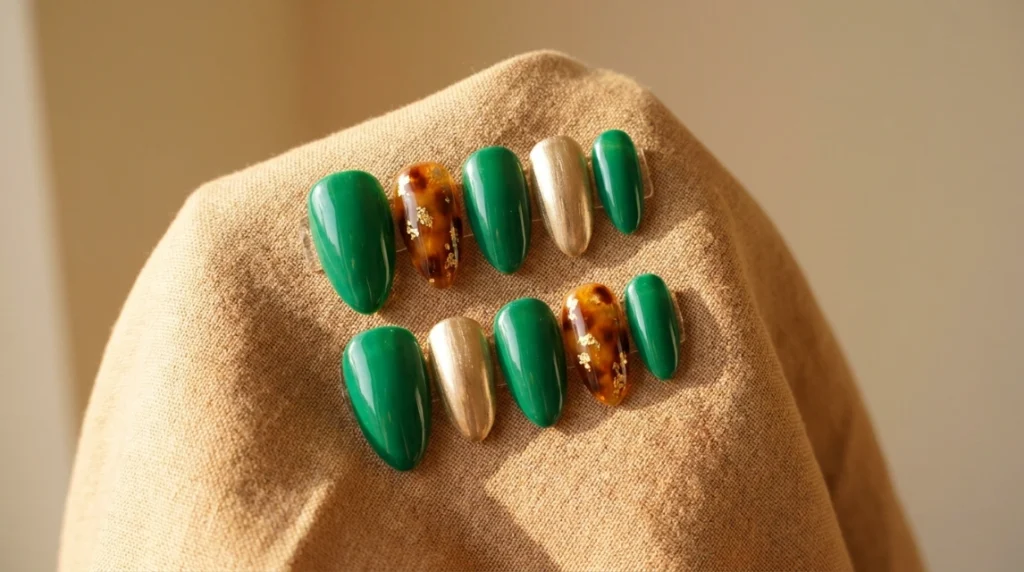
Step 7 — Seal with high-gloss top coat
Finish every nail with a high-shine top coat. The gloss is doing real work here: it’s what makes the emerald look like a gemstone and the tortoiseshell look like polished shell instead of muddy brown polish.
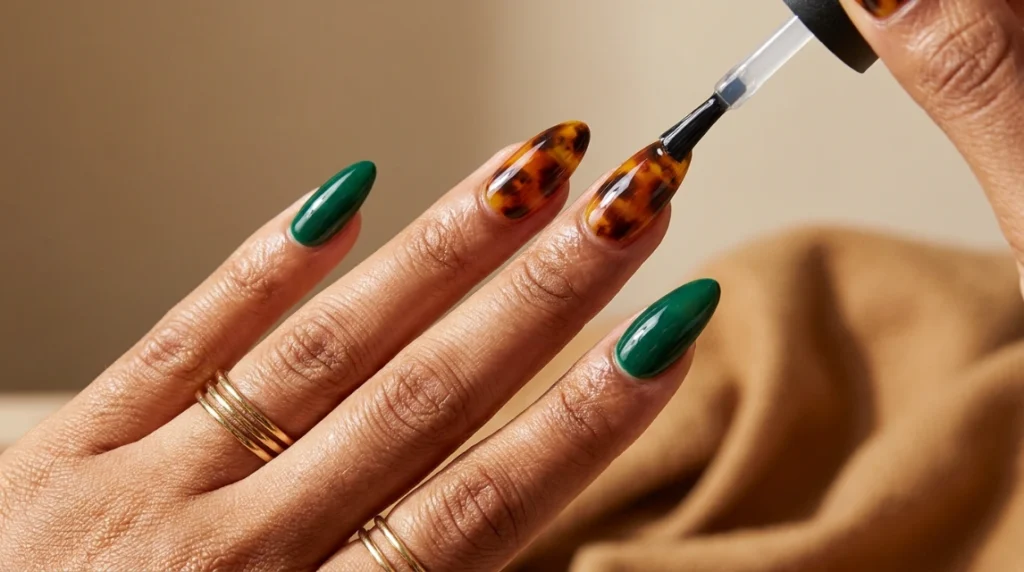
How to Make Tortoiseshell Nails Look Realistic (Not Leopard Print)
This is the number one thing that trips people up. Leopard print uses defined, rounded spots with a clear outline. Tortoiseshell uses irregular, translucent layers with soft, blended edges and no consistent shape repeating across the nail. If your pattern is starting to look like a big cat, blend your edges more and vary the size and shape of every patch — no two should look alike.
10 Ways to Style This Color Combination
- Emerald + classic tortoiseshell — the original, most balanced version
- Emerald + amber tortoiseshell — a lighter, honey-toned variation
- Emerald + dark chocolate tortoiseshell — deeper and more dramatic
- Emerald French tip + tortoiseshell — a soft compromise for first-timers
- Emerald chrome + tortoiseshell — adds shine without adding gold
- Matte emerald + glossy tortoiseshell — a finish-based contrast instead of a color one
- Emerald + tortoiseshell + micro-gold liner — the full editorial look
- All-tortoiseshell with one emerald accent nail — great for those who want subtlety
- Short almond in emerald and tortoiseshell — the office-friendly version
- Long almond, full formula — the most dramatic, photo-ready version
How to Turn This Into Press-On Nails
Option A — Paint directly onto press-on tips. This gives you a consistent shape to work with and makes it far easier to build an even tortoiseshell pattern than trying to paint it on natural nails one at a time.
Option B — Design before applying. Lay out your full set of tips, decide which nails will be emerald, which will be tortoiseshell, and which get gold accents, then paint the entire set at once so the color balance looks intentional across all ten nails. Let everything cure and dry completely before applying to natural nails with nail glue or adhesive tabs — rushing this step is the most common reason press-ons lift early.
How to Make the Look More Wearable
- Everyday: more emerald, fewer tortoiseshell nails, no gold
- Office or school: short almond shape, one subtle tortoiseshell accent nail
- Events or nights out: long almond shape with full gold detailing
- Maximalist/fashion-forward: more tortoiseshell coverage plus visible metallic accents
What to Wear With Emerald & Tortoiseshell Nails
This palette was built to sit alongside a specific wardrobe: cream, ivory, camel, chocolate brown, and black, paired with gold jewelry and leather accessories. The nails work best as part of a full look rather than standing alone — think the same neutral-plus-jewel-tone formula you’d see in old-money style guides.
Common Mistakes to Avoid
- Too much gold — turns the look busy and costume-like instead of refined
- Flat tortoiseshell — skipping the translucent layering step leaves you with plain brown polish
- Perfectly round spots — reads as leopard print, not tortoiseshell
- Too many competing colors — stick to the three-element formula
- Thick, uneven layers — can make the pattern look muddy instead of dimensional
- Low-shine finish — removes the glassy, jewel-like effect that makes the whole look feel expensive
Maintenance Tips
Protect your glossy top coat by avoiding excessive soaking (dish soap, hot tubs, and long baths break down polish faster). Use cuticle oil daily to keep the surrounding skin healthy, touch up any chips as soon as you notice them rather than waiting, and when it’s time to remove the set, soak off gel properly instead of picking or peeling — picking can damage the natural nail bed underneath.
FAQ
Are emerald green and tortoiseshell nails classy? Yes — the combination reads as sophisticated because it leans on depth and texture rather than sparkle or bold color-blocking, which is what gives it that “quiet luxury” feel.
What colors go with emerald green nails? Tortoiseshell brown, gold accents, camel, cream, and black all pair naturally with emerald because they echo the warm-neutral palette associated with luxury styling.
How do you make tortoiseshell nails? Layer a translucent amber base, add irregular brown patches in varying shades, then blend with another sheer layer to soften the edges and create depth.
Can you do tortoiseshell nails without gel? Yes — regular polish works, though gel makes the layering and blending steps easier to control since it doesn’t dry as quickly between layers.
Are emerald green nails good for fall? Yes — emerald pairs naturally with the warm browns and golds associated with autumn, making it a strong seasonal transition color from summer brights into fall neutrals.
What nail shape looks best with emerald green? Almond and long almond are the most versatile, though the color combination works across coffin, stiletto, and short almond shapes as well.
Can this design be made with press-on nails? Yes — painting the design directly onto press-on tips is often easier than working on natural nails, since it lets you complete the full set before application.
What colors make nails look expensive? Deep jewel tones like emerald, paired with warm neutrals like tortoiseshell and small metallic gold accents, are consistently associated with a higher-end, more polished look than bright or pastel shades.
Image Plan — Continuous Photo Story
Every image below is written to continue the same manicure, same hand, same lighting setup, and same jewelry styling from start to finish — so the set reads as one continuous shoot rather than stock photos stitched together. Skin tone, hand pose, background, and prop stay consistent across the whole sequence; only the nail stage and camera angle change.
Reference constants (use in every prompt): medium-tone hand, long almond nails, thin stacked gold rings on the ring and index fingers, soft neutral warm-beige background with a folded camel-colored fabric prop, natural warm side lighting, true-to-life color reproduction, vertical 2:3 Pinterest composition, no text overlay unless noted.
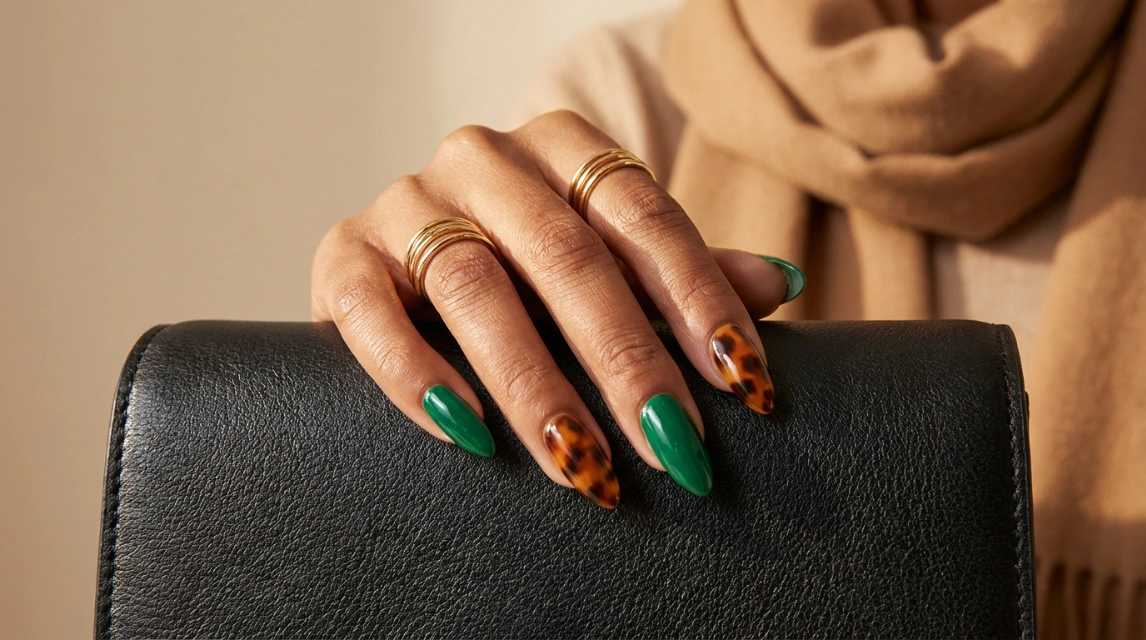
- Featured image (no text overlay): Finished emerald and tortoiseshell manicure, hand resting on a closed black leather handbag, fingers loosely fanned, thin gold rings visible, glossy high-detail close-up.
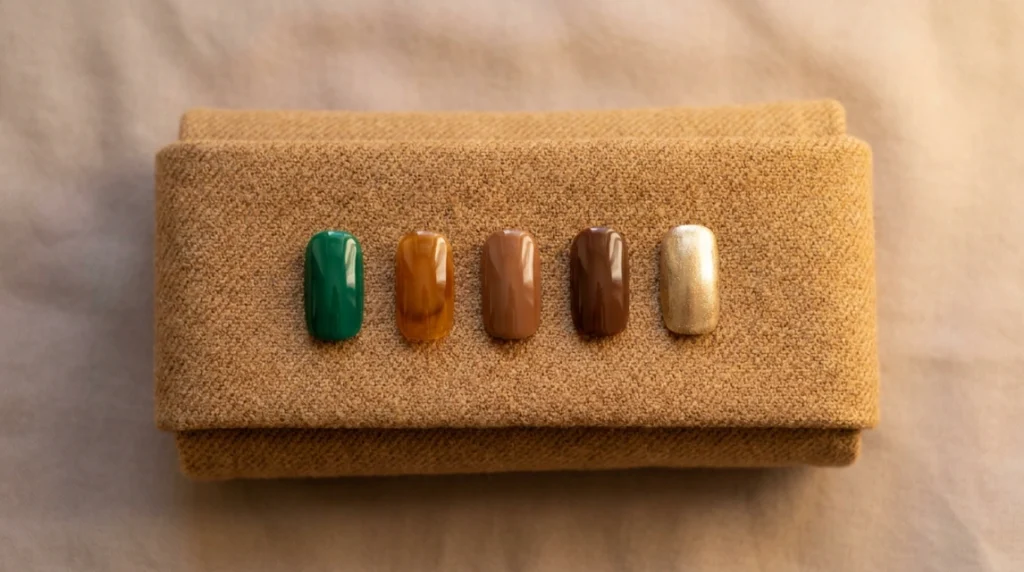
- Color palette flat lay: Five small polish swatches in a row — emerald, amber, medium brown, chocolate brown, gold — on the same camel fabric background, no hand, soft overhead lighting.
- Why it works, three-panel composition: Same hand, one panel showing only the emerald nails in focus, one showing only the tortoiseshell nails, one showing only the gold accent detail, arranged as a single vertical triptych.
- Step 1 — Prep: Same hand, bare clean nails only, cuticles pushed back, one hand holding a base coat brush above the nails, same background.
- Step 2 — Emerald application: Same hand, two nails freshly painted emerald and glossy, remaining nails still bare, brush resting beside the hand.
- Step 3 — Tortoiseshell base: Same hand, tortoiseshell nails now showing a sheer amber base only, no brown patches yet, emerald nails from Step 2 already finished beside them.
- Step 4 — Brown patches: Close macro shot of a single tortoiseshell nail mid-application, fine detail brush adding irregular dark brown patches over the amber base.
- Step 5 — Translucent layering: Same macro angle as Step 4, now showing the same nail with a glassy, layered, dimensional tortoiseshell pattern fully blended.
- Step 6 — Gold detailing: Close macro shot of a fine liner brush adding a single thin gold line along the edge of one emerald nail.
- Finished manicure, alternate angle: Full hand, all ten nails complete, different pose than the featured image — hand gently curved holding a small gold-accented clutch or cup, same background and lighting.
- Press-on version: A complete set of ten loose press-on tips arranged in a fan or row on the camel fabric, painted in the same emerald/tortoiseshell/gold pattern, no hand, before application.


2 Comments