How to Remove Nail Glue Residue From Skin and Nails
There are two different glue problems, and they need two different fixes. Fresh glue that seeps onto skin during application comes off fastest with a dry cotton swab, pressed and rolled, before it ever sets. Dried residue left behind after removing a full set needs a soak first, then a slow, sliding scrape, never a pull. Either way, the fastest way to remove nail glue residue is to soften it first and never pick at it dry.
Most people only learn one of these tricks and try to use it for both situations, which is exactly why the glue “won’t come off.” Here’s the full process to remove nail glue residue from both skin and nails.
Problem 1: Glue That Seeps While You’re Applying
This is the glue that squeezes out around the edge of a press-on the moment you press it down. Catch it now and it’s a ten-second fix. Miss it and it dries into a stubborn little bead that fights you later.
What actually works:
- Let the nail set for about 20 seconds first so you don’t shift it.
- Take a dry cotton swab and lay it flat against the wet glue instead of wiping. Let it soak in for a second, then roll it away from the nail rather than smearing it across the skin.
- Use a fresh swab tip for every spot. A used tip just moves wet glue to a new place.
- If a little residue is left after the dry swab, follow with a second swab lightly dampened in isopropyl alcohol or acetone based remover. Alcohol is gentler and works fine on glue that’s still soft.
- Press the nail down again for another 20 to 30 seconds once the area is clean.
Prevent it before it happens: run a thin layer of Vaseline or cuticle oil around the cuticle and skin edge before you glue anything down. Glue doesn’t bond to the oil, so any seepage wipes away instead of sticking.
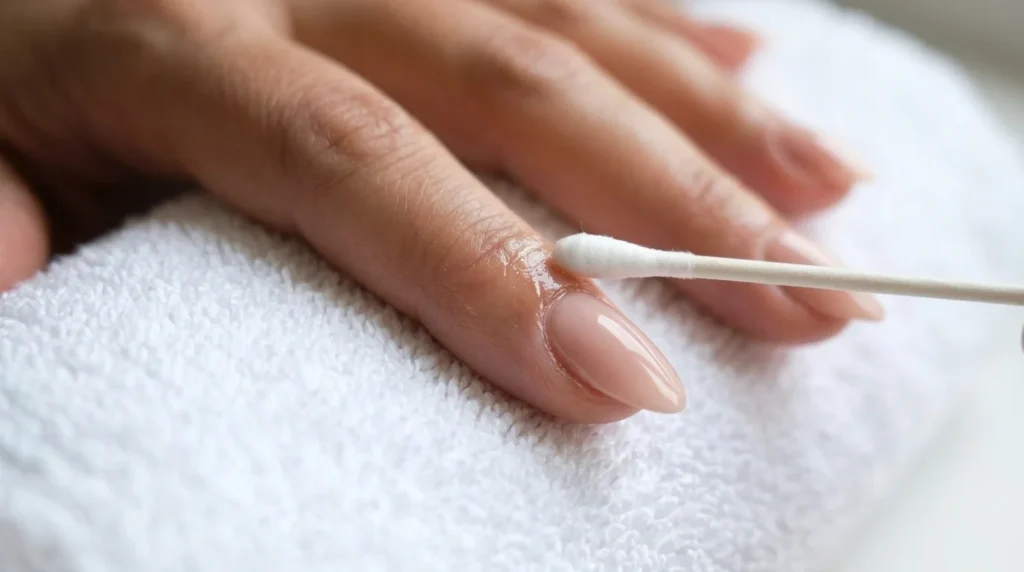
How to Remove Nail Glue Residue From Dried Skin
If you missed the wet window and the glue has already hardened on skin, don’t pick at it. Picking is what turns a small glue spot into a raw patch. Instead:
- Apply a generous amount of cuticle oil or a thick layer of hand cream directly over the dried spot.
- Rub it in gently with a fingertip in small circles for a minute or two. The oil works into the edges of the dried glue and starts to loosen its grip on the skin.
- Keep rubbing gently until the glue balls up and rolls off on its own. This can take a few minutes for a larger spot.
- Wash with warm water afterward and moisturize again.
This is slower than acetone but far gentler, and it’s the better option for cuticles and thin skin where acetone tends to sting. According to the American Academy of Dermatology’s guidance on nail care, repeated use of harsh solvents on skin can contribute to dryness and irritation over time, which is another reason to reach for oil first on sensitive areas.
How to Remove Nail Glue Residue From the Natural Nail
This is the one that trips people up the most, and it’s a different job entirely from cleaning skin. Once press-ons come off, a thin film of hardened glue is often still bonded to the nail plate itself. Rubbing alcohol and regular nail polish remover generally do nothing here. This needs a proper soak followed by mechanical removal, done carefully.
The soak-and-scrape method:
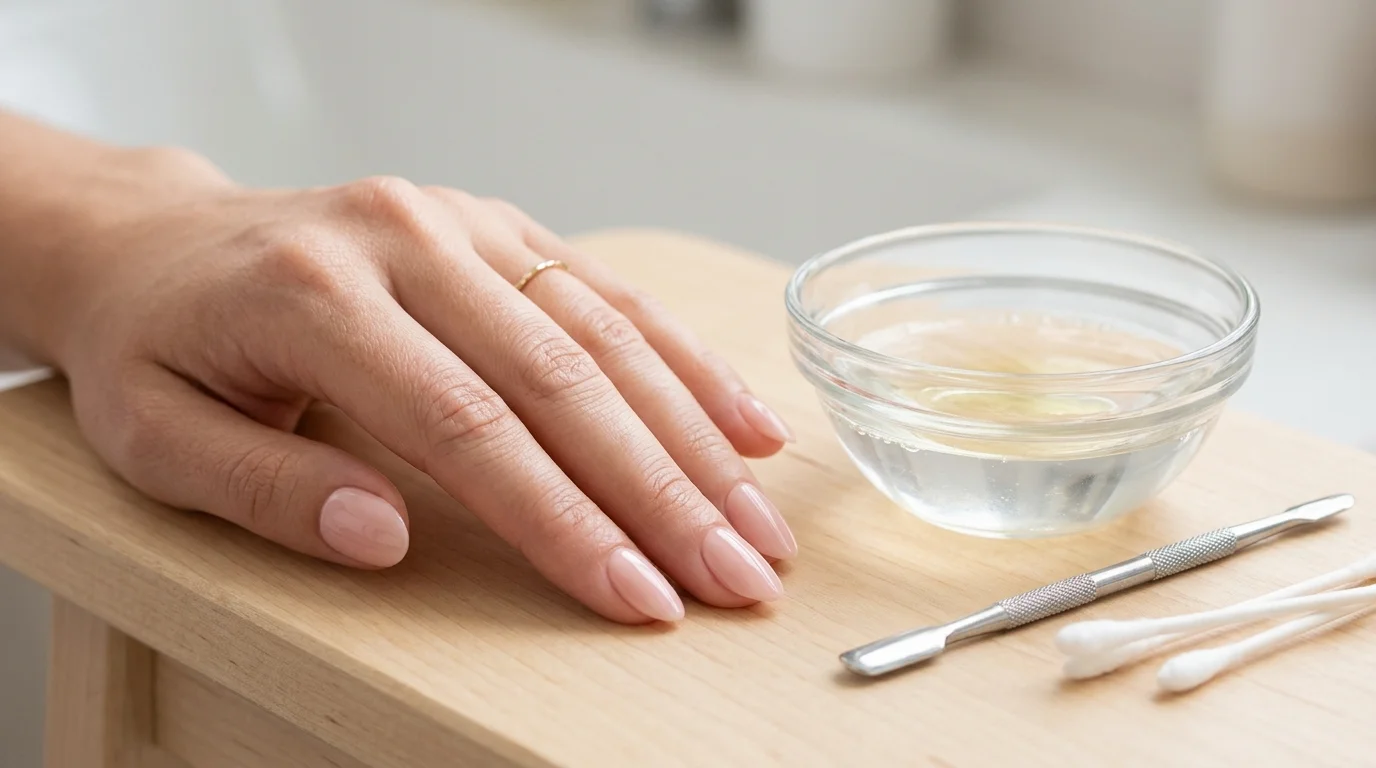
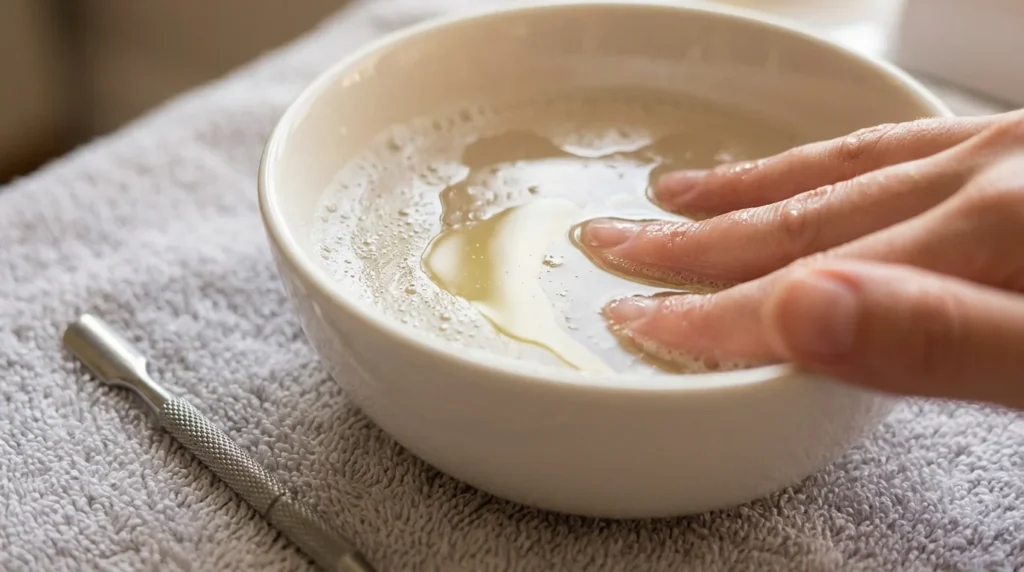
- Mix hot water (as warm as is comfortable), a squeeze of dish soap, and a splash of cooking oil in a bowl.
- Soak your fingertips for at least 5 minutes. The combination softens the glue more effectively than water alone, since the oil helps break the bond while the soap lifts it.
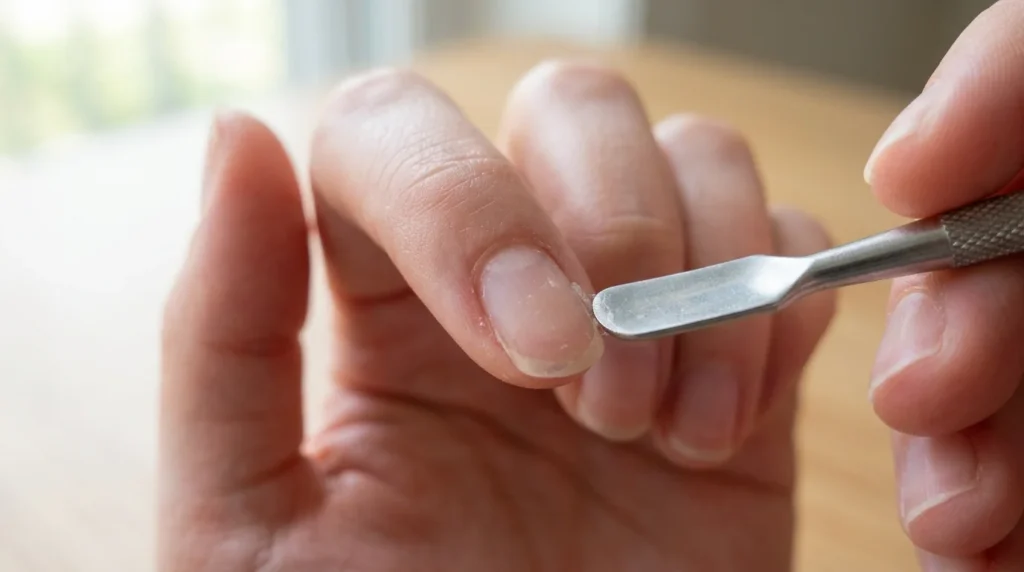
- Use a metal cuticle pusher with an angled or triangle tip. Starting from the side of the nail, slide the tool slowly and flatly between the nail and any remaining glue or press-on. The motion should be a slide, not a pull.
- Once any leftover set is off, use the same tool to gently scrape the residual glue film off the nail plate while it’s still softened from the soak. Light, flat strokes only.
- If a full set still won’t budge after a first soak, don’t force it. Re-soak for another 5 minutes and try again.
If glue still won’t lift after soaking: a fine-grit nail file, or an electric file on its lowest setting, can buff away a stubborn residual film. Go slowly, in one direction, and stop the moment the surface feels smooth or the skin nearby shows any redness. This is a last resort for the nail plate only, never for skin.
Why the Same Glue Doesn’t Always Behave the Same Way
Not all nail glue removes the same way, even when the application looks identical. Cheaper glues tend to bond just as strongly as name-brand ones, but they’re often harder to release cleanly and more likely to leave nails feeling rough or thin afterward. If a particular glue keeps giving you the same removal struggle every time, the fix isn’t a stronger remover, it’s switching formulas. Brush-on glues also tend to seep less than squeeze-tube glues, simply because they put down a thinner, more controlled layer to begin with.
Most nail glues use cyanoacrylate, a fast-curing adhesive family also referenced in the FDA’s overview of medical adhesive devices, which is part of why it bonds so quickly and needs a deliberate soak-based process to release rather than a quick wipe.
When to Skip the DIY Route
If a full set has been stuck for several days, acetone and alcohol have both been tried with no result, and picking has already started to hurt, stop trying to force it at home. At that point an electric file used carefully, or a quick trip to a salon for a proper soak-off, is safer than continuing to peel at a bond that isn’t releasing. Ongoing pain, redness, or thinning of the nail plate is a sign to stop and let a professional finish the job. For more on getting glue off skin safely in the first place, see our guide on how to get nail glue off skin.
If you’re still working out which glue to use before your next set, our guide to the best nail glue for press-ons covers which formulas tend to release the cleanest.
FAQ
Why does acetone work on some nail glue and not others? Acetone breaks down cyanoacrylate effectively, but a thick, fully cured layer takes longer to soften than a thin one. If it feels like acetone “isn’t working,” the more likely issue is that the glue hasn’t soaked long enough, not that the product has failed. A longer soak, or a hot water and oil soak first, usually gets it moving.
Is it safe to file glue residue directly off my nail? Yes, as long as you’re filing the glue film and not the nail plate underneath, and you stop as soon as the surface feels even. Filing works best after a soak has already softened the glue, not on a bond that’s still fully hard.
What’s the fastest way to clean glue that just seeped onto my skin? A dry cotton swab, pressed and rolled away from the nail, right after the seepage happens. This is faster and gentler than reaching for acetone every time, and it won’t dull the shine on the nail itself.
Can vaseline really stop glue from sticking to my cuticles? Yes. A thin barrier of Vaseline or cuticle oil around the nail before application means any glue that squeezes out sits on top of the oil instead of bonding to skin, so it wipes away rather than needing to be soaked off later.
What’s the easiest way to remove nail glue residue at home without damaging your nails?
The safest approach is to soften it before touching it. Soak in warm water with a little dish soap and oil for at least five minutes, then slide a metal cuticle pusher flat against the nail instead of scraping or picking. This is the method that consistently works to remove nail glue residue without thinning the nail plate or tearing skin, and it beats reaching for a sharp tool on glue that hasn’t been softened first.
How long does it take to remove nail glue residue completely?
It depends on how thick the glue is and which method you use. A dry cotton swab clears fresh seepage in seconds, but dried residue on the nail plate usually needs a full 5 to 10 minute soak before it’s soft enough to slide off cleanly. Rushing the soak is the main reason people struggle to remove nail glue residue without picking or scraping too hard.